

Change story: the 'why' behind the change
You don't get change through an organisation with a plan, with goals, processes and systems. Of course, those play an important role. But it starts with the employee. A person who sees why change is needed. Who perhaps doesn't want it at first, but does feel the urgency. Because, at last, someone is telling them clearly what's at stake, what's needed and what support they'll get to achieve it. The employee who sees their manager start to behave differently, who sees the colleague who has been preaching change for years suddenly get more room, and who comes across great examples everywhere: on the intranet, in the workplace and in team meetings. Colleagues who share experiences and help each other take the next step.
Change often starts with the 'soft' side: mindset, a sense of urgency, an inspiring perspective, shared meaning. Then comes the 'hard' side of change: reward agreements, processes and structure. Change doesn't happen overnight. But it begins with a clear starting point: the change story, the foundation for the 'soft' side of the change your organisation is facing.
Change according to McKinsey
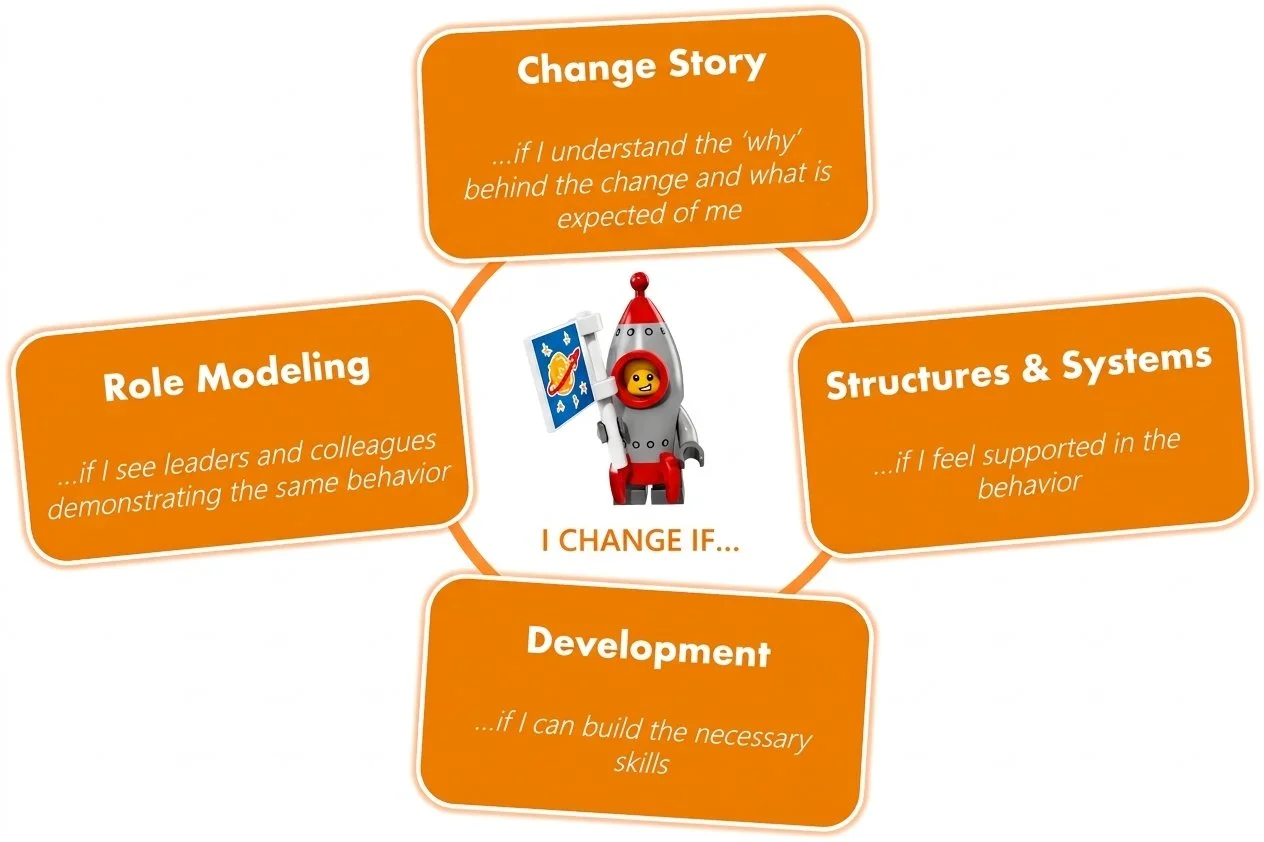
When employees know not only what is changing, but above all why, their motivation to move with it grows. According to McKinsey, a powerful change story is crucial: it creates clarity about the organisation's direction, shows why change is unavoidable, and highlights the benefits for everyone. Such a story works like a compass: it gives the organisation direction and strengthens employee engagement and motivation. In its Influence Model, McKinsey distinguishes four pillars of change:
Change story: understanding and feeling the 'why' of the change
Role modelling: seeing the change around you
Developing skills: being able to do it yourself
Structures and systems: being supported and encouraged
In this article, we zoom in on step 1, the change story, but always within the context of the other elements.
Three building blocks of a change story
A change story describes concisely, and with emotion, what the current situation is, why change is necessary and what the desired situation looks like. A change story is built on three pillars: urgency, imagination and dealing with uncertainty.

1. Urgency: why do we need to get moving?
Why does anything actually need to change? Many organisations struggle to put this into words and explain it well. In the world of stories, we call this the call to adventure. It's the moment Frodo receives the ring from Gandalf, with the task of destroying it. The moment Nemo is caught by a diver and his father has to cross the ocean to find him. Something has to happen; the hero has to set out. What is it for your organisation?
2. Imagination: what does the new world look like?
Martin Luther King took his audience into a new world with his iconic "I have a dream" speech. He sketched a dream world, seen through the eyes of his children, in which they could grow up without racism. Stories are unrivalled at showing a new reality: 'imagine if…'. What is the dream you're chasing with the change? What does it look like once it has come true? How do people behave then? What do customers notice? What has changed?
3. Dealing with uncertainty: what if it gets tough?
A good change story has room for success, but certainly also for difficult bumps in the road and the uncertainty of trying new things. Because in every change, something has to be overcome. Many boards find this difficult. They like to paint 'a dot on the horizon' and the beautiful things that glimmer there, without paying attention to the difficulties and dangers along the way. Those are there, and you'd better name them. Uncertainty about the future? Nervousness about trying something new? Show that it's allowed to be there, that it's part of a change process, and how you support people in dealing with these difficulties. What can my manager do for me? How can I develop new skills? How will renewed agreements and processes help me?
“I’m incredibly happy with this foundation; the story is rock solid. This is the passion and the heart of our organisation!”
Communication is everything. And everything is communication.
Your change story is ready. It has been written with input from the board, front-runners, those lagging behind, communication, HR and organisational development. It rings true for everyone involved in the change. So how do you get the change story off the page?
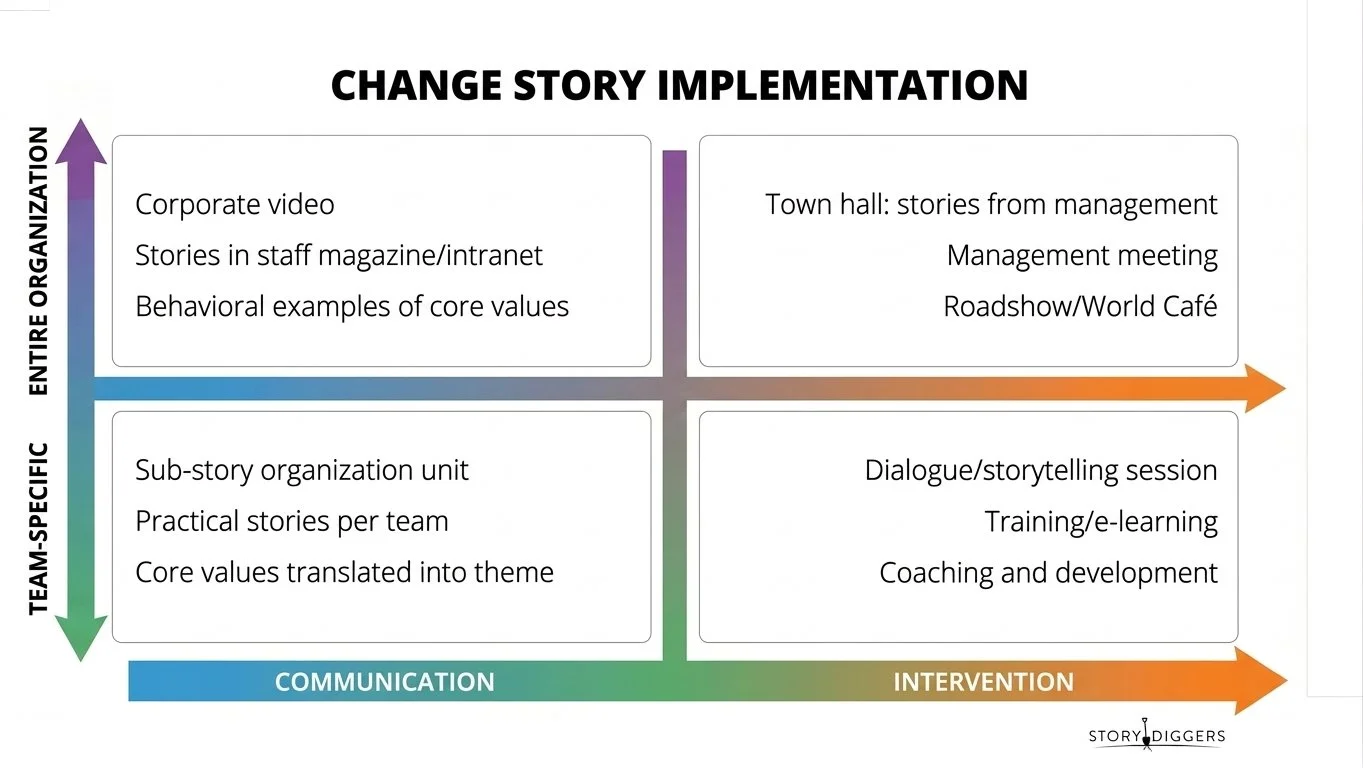
Communication is what you see in writing, but also how your colleague behaves. It's an inspiring video, but also what happens in a performance review. The change story comes to life through communication channels (intranet, staff magazine, memos, best practices, etc.) and through interaction (team meetings, town halls, training sessions, development conversations, etc.). A good implementation plan includes both. Some things you develop for the whole organisation, and other initiatives specifically for certain teams. This leads to the implementation matrix below. It gives you a firm grip on the further roll-out. Not every element has to be carried out straight away; a good phasing is in order.

The change starts before the story is even finished
Creating a change story is at least as important as the result. In the conversations and workshops, employees become increasingly aware of what the change challenge is and what it takes. This often leads to new initiatives before the story is even finished, because people start looking at the way they work and their behaviour with fresh eyes. In that sense, creating a change story is already a powerful start to the desired organisational development, and it offers plenty of starting points to drive it further and shape it.
Your change story sets things in motion
Change starts with the 'soft' side (mindset and a sense of urgency) and with making role-model behaviour visible through stories on the intranet, in the workplace, during a town hall or in a team meeting. Then the 'hard' side comes in naturally: how do we support this with the right training, work procedures and systems? Of course, in practice things often overlap. But we hope the above gives you something to hold on to in the change you are facing, or may already be in the middle of.
Examples from our practice (in Dutch)


Ready to dig?
It starts with a good change story. And that isn't a copywriting job. It's a strategic and creative process. It calls for reflection, courage and sharp questions.
We help you find that story, put it into words and translate it into action. So that your organisation doesn't just say what it does, but shows why it matters. That really gets things moving. We're ready with a fresh pair of eyes and a sturdy spade.

Ralph Poldervaart (founder)
ALD Automotive heeft een ambitieus strategisch plan waarin duurzaamheid, flexibiliteit en innovatie een belangrijke rol spelen. Om de betekenis van de nieuwe koers over te brengen aan alle medewerkers is meer nodig dan een strategisch document. Het achtkoppige managementteam besloot persoonlijke verhalen in te zetten om de strategie intern tot leven te brengen. En dat tijdens een lockdown…